
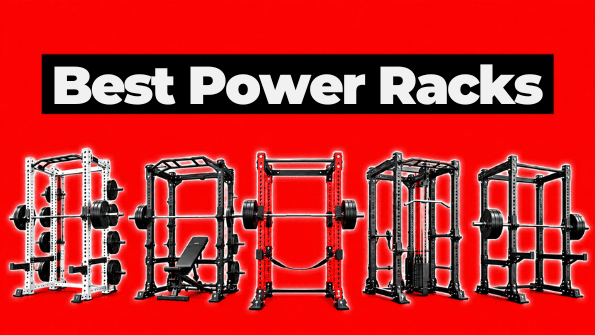
If you want the short version, if I were buying one power rack for a home gym today, I’d buy the
I’ve owned mine for years, used it in my own gym and with clients, added attachments to it, dealt with the little annoyances, and I still haven’t found a good reason to replace it with something more “premium” just so I can say I did.
What I care about in a power rack is pretty simple: does it fit your room, does it give you enough adjustment, can you build around it over time, and does it stay out of your way once you start adding safeties, storage, cables, and attachments? That’s where a lot of racks that look amazing on a spec sheet start becoming a pain in the ass.
The PR-4000 gets that balance right for most home gyms. You get a 3×3, 11-gauge frame, 5/8-inch hardware, Westside spacing through the bench zone, plenty of height and depth options, and a massive REP attachment ecosystem without paying extra for 1-inch hardware you may never actually need.
It isn’t perfect. REP’s metric tubing can be annoying with some third-party attachments, and if you start bolting every possible cable, storage, and Smith attachment onto the rack without thinking through the layout first, you can absolutely make the rack worse.
But after years of owning it, that’s still the standard I’m using for this guide: not which rack has the highest power level on a spec sheet, but which one is least likely to make you regret buying it once it’s actually taking up space in your gym.
I also haven’t personally used every rack in this guide, and I’m not going to pretend I have. When I’m speaking from my own experience, I’ll tell you. When a recommendation is based on current specs, manufacturer documentation, and outside research, I’ll make that clear too.
Some links in this guide are affiliate links, which means I may earn a commission if you buy through them. That does not change what I recommend or how I rank anything.
I last refreshed the research, pricing, stock, warranties, and configurations on October 6, 2026. Those things can change, so check the current product page before you order.
Before You Buy Another Piece of Gym Equipment, Score It First.
Run the purchase through two hard stops and eight practical checks for space, training value, budget, overlap, and long-term usefulness.
My Quick Picks – Which Power Rack Fits You?
- Best Overall: REP PR-4000 – The one I’d buy for most serious home gyms.
- Best Premium: Bells of Steel Manticore – If you specifically want a premium true-3×3, 1-inch ecosystem with strong cross-brand compatibility.
- Best American-Made: Rogue RM-4 Monster – If U.S. manufacturing and Rogue’s Monster ecosystem are worth paying more for.
- Best Value: Titan X-3 – If you want a 3×3 rack and care more about value than premium finish or warranty.
- Best First Power Rack: REP PR-1100 – If this is your first rack and you want to keep the upfront cost low.
- Best For Low Ceilings: Titan T-2 – If ceiling height is the thing screwing up every other option.
- Best Folding Rack: PRx Profile PRO – If getting your floor space back after training matters more than having a full cage.
- Best Budget: Bells of Steel Light Commercial – If you want to spend less now without buying something you’ll immediately outgrow.
Power Rack Comparison
These are the eight racks I think are actually worth comparing for the main buyer decisions in this guide. I’m using realistic current cost references where I can instead of cherry-picking the cheapest frame-only price.
Prices, sales, and builder configurations move around, so treat these as comparison points, not guaranteed checkout totals.
If you need broader rack education first, browse my power rack and squat rack guides.
| Rack | Current Cost Reference* | Hardware | Size | Main Tradeoff |
| REP PR-4000 | From $799.94 pre-selected; builder total varies | 3×3″, 11-gauge, 5/8″; 1″ bench-zone spacing | 80″/93″; 16″/24″/30″/41″ depth options | Metric attachment-fit quirks; final price depends heavily on configuration |
| Bells of Steel Manticore | About $1,400 for the current four-post prebuilt reference; builder varies | True 3×3″, 11-gauge, 1″ | Multiple height/depth configurations | Higher price, and exact builder configuration and availability can change |
| Rogue RM-4 | $1,830 with current J-cup + strap configuration; stabilizer may add cost | 3×3″, 11-gauge, 1″ | 80.375″–108.375″; 43″ rack depth; 53×53″ footprint | Price, wide 49″ rack geometry, and the bolt-down/stabilizer decision |
| Titan X-3 | $706.94 with current 24″ pin/pipe safeties | 3×3″, 11-gauge; 11/16″ holes; Westside spacing | 90″; 24″ inside depth; 45×52.5″ overall footprint | Safeties cost extra; 1-year warranty; finish/QC tradeoffs |
| REP PR-1100 | $379.99 incl. J-cups + pin/pipe safeties | 2×2″, 14-gauge; 1″ holes; 3″ spacing | 85″; 58.1″ W x 48.5″ D | 3″ spacing, lighter frame, and a lower long-term upgrade ceiling |
| Titan T-2 | $399.97 current sale incl. J-hooks + pin/pipe safeties | 2×2″, 14-gauge; 26 mm holes; 2″ spacing | 71″/83″; 26″ inside depth; 57×50″ footprint | Lighter 2×2 platform, smaller upgrade ceiling, and 1-year warranty |
| PRx Profile PRO | $1,339.98 with current compatible spotter arms | 3×3″, 11-gauge, 5/8″ | 73″/81″/89″/95″; 22″ from wall deployed; about 4″ stored | Wall, ceiling, floor, and installation geometry; not a full cage |
| Bells of Steel Light Commercial | $799.99 standard 84.5″ reference | 2.3×2.3″ / 60 mm, 12-gauge, 5/8″; 1″ bench-zone spacing | 84.5″ standard / 72″ short; lat tower requires standard height | More proprietary 60 mm ecosystem and less cross-brand compatibility than true 3×3 |
Prices and configurations can change. REP and Bells builder totals vary by setup, while Titan and PRx pricing may move with sales and accessories. Check the current product page before ordering.
Best Overall – REP PR-4000
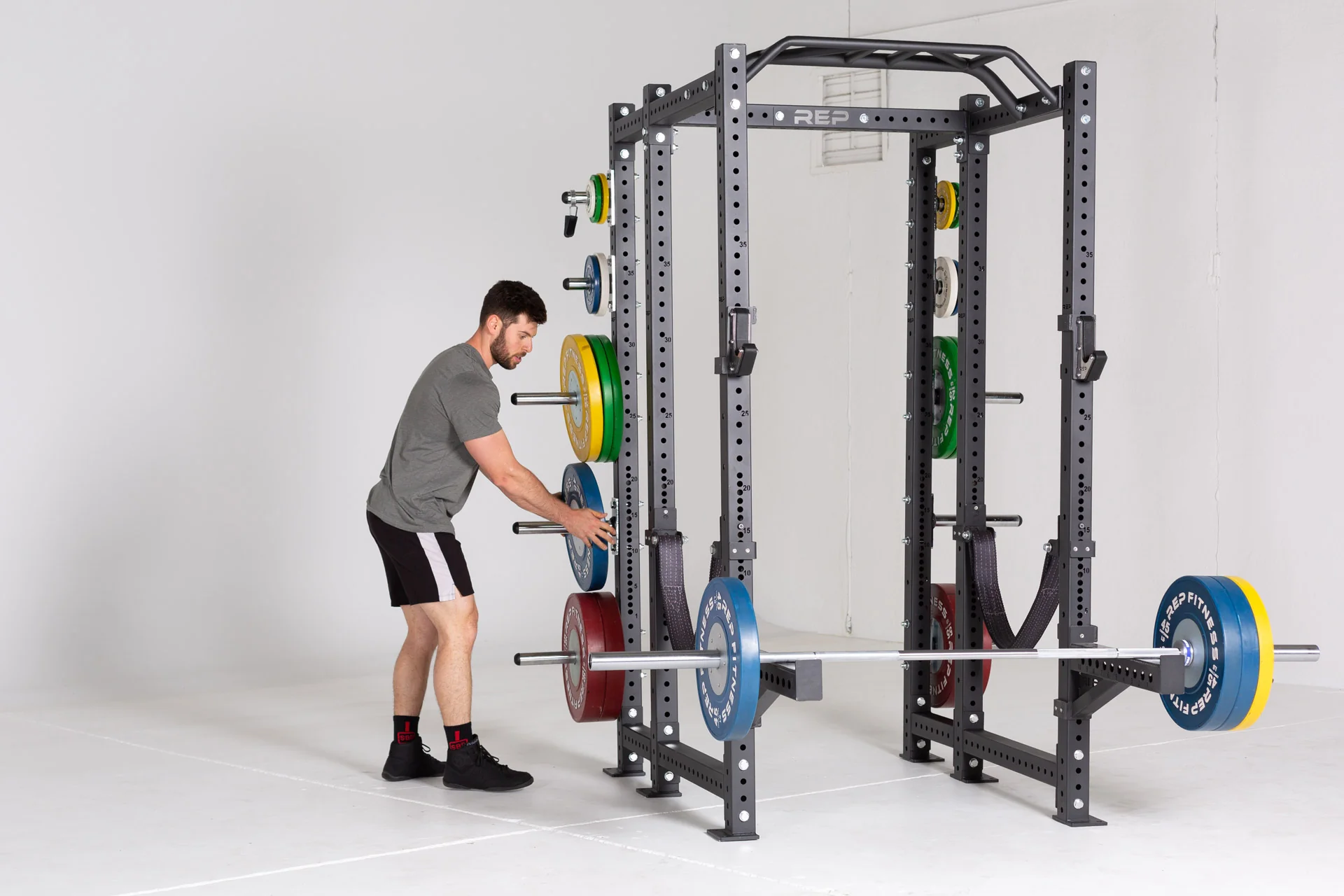
The REP PR-4000 is the rack I’d recommend to most serious home gym owners. I’ve owned mine for years, and it gives you the right balance of adjustment, ecosystem, and long-term expandability without paying extra for features most people will never need.
- Great balance of price, adjustability, and upgrade options
- Tight bench-zone spacing makes J-cup and safety setup easier
- Multiple height and depth configurations
- Large REP attachment and cable ecosystem
- Owned long-term and still more rack than I need
- Metric tubing can make some cross-brand attachments fit imperfectly
- Configured price climbs quickly with cables, storage, and premium attachments
- Some configurations need bolting or a stabilizer
- Not the cheapest way to get a full cage
- Buyers committed to 1-inch hardware may prefer a different ecosystem
The
I bought mine after comparing it with the PR-5000, and years later I still think the PR-4000 is the better default for most serious home gym owners.
That recommendation is not based on which rack has the biggest hardware or the highest capacity number. It is based on living with the thing.
I have built my gym around it, trained on it for years, used it with clients, added storage and attachments, and still have not reached a point where the rack itself is holding me back.
Why The PR-4000 Wins Overall
The PR-4000 hits the point where spending more starts giving you smaller returns.
You get 3×3″ 11-gauge uprights, 5/8″ hardware, Westside spacing through the bench zone, multiple height and depth options, and one of the better rack ecosystems available for a home gym.
More importantly, you get those things without automatically paying for 1″ hardware that most people do not actually need.
That is why I still prefer it to the
The PR-5000 is a great rack, but moving from 5/8″ to 1″ hardware does not suddenly make your squats safer, your bench stronger, or your rack more useful for normal home-gym training.
What it really changes is the ecosystem.
If you specifically want REP’s 1″ attachment system, that can absolutely be worth paying for. I just do not think it is the better default.
The same applies to racks like the Bells of Steel Manticore and Rogue RM-4 Monster. They give you true-imperial 3×3″ construction and premium 1″ ecosystems, but you are paying more for advantages that matter most to a narrower type of buyer.
On the other end, something like the
The PR-4000 sits in the middle of those decisions extremely well.
What Years Of Ownership Actually Taught Me
The biggest compliment I can give the PR-4000 is that I have not outgrown it.
When I originally built mine, I went with a six-post setup, 80″ uprights, and 41″ crossmembers because I wanted enough room to squat and bench inside the rack while still fitting comfortably in my garage.
I added plate storage, strap safeties, sandwich J-cups, and a multi-grip pull-up bar.
The exact configuration matters less than what happened afterward: I kept adding to the gym without needing to replace the rack.
That is what I want from an expensive piece of home-gym equipment.
A PR-4000 can start as a relatively simple four-post rack and grow into a six-post setup with storage, upgraded safeties, different J-cups, cable systems, dip attachments, landmines, and other accessories.
REP is also still actively developing the 4000 Series.
That matters.
A rack having 50 attachments today is not nearly as useful if the company stops supporting the ecosystem three years from now.
Where The PR-4000 Falls Short
The biggest downside is compatibility.
REP’s uprights are metric rather than true-imperial 3×3″, so I would never assume a third-party attachment fits perfectly just because both companies call their racks 3×3″.
I have dealt with third-party attachments that had some slop and used UHMW to tighten the fit.
Single-pin accessories are usually the easier case. Multi-pin attachments are where I would verify compatibility before spending money.
The second issue is complexity.
Once you start combining storage, cables, trolleys, safeties, Smith attachments, and other large accessories, you have to think about where everything actually goes.
A rack can technically support an attachment without that attachment making the rack better to use.
That is not really a PR-4000 failure. It is what happens when one rack starts trying to become half the gym.
Still, if your plan is to build a heavily customized rack, check REP’s compatibility requirements before assuming every attachment combination works with every depth and post configuration.
Who The PR-4000 Is Best For
I would buy the PR-4000 if you want one rack that can stay in your gym for years and you expect the gym around it to evolve.
It makes the most sense if you want:
- A serious 3×3″ 11-gauge rack without jumping straight to premium 1″ hardware.
- Westside spacing for better bench setup.
- Multiple height and working-depth options.
- A large native attachment ecosystem.
- The ability to add storage or cable systems later.
- A rack you are unlikely to outgrow just because your home gym gets more complicated.
If that describes what you are building, this is still the rack I would start with.
Who Should Skip The PR-4000
I would skip the PR-4000 if you want the same general 3×3″ / 5/8″ rack platform but prefer true-imperial tubing and broader cross-brand attachment compatibility.
In that case, the Bells of Steel Hydra is the alternative I would look at.
The PR-4000 is still my pick for most people, but the Hydra makes more sense if cross-brand attachment compatibility is a higher priority.
If you want the deeper ownership side of this recommendation, read my full REP PR-4000 review.
Best Premium – Bells of Steel Manticore
The Manticore is the premium rack I’d choose when true-imperial construction and broader cross-brand attachment compatibility are the priority.

The Manticore is the rack I would look at if I wanted a premium 1″ platform without locking myself as tightly into one company’s exact tubing standard.
Its biggest advantage is not that 1″ hardware is magically stronger for normal home-gym training. It is the ecosystem.
You get true 3×3″ 11-gauge uprights, 1″ holes, multiple height and depth options, a deep Bells attachment lineup, and cleaner compatibility with matching-spec third-party attachments than you generally get from metric 75mm racks.
That does not mean every 3×3″ attachment from every company is automatically going to fit perfectly. Hole spacing, rack width, and multi-pin designs can still create compatibility problems. But if mixing brands is part of your long-term plan, true-imperial 3×3″ gives you a better starting point.
That is what you are really paying for with the Manticore: a premium 1″ ecosystem with a higher compatibility ceiling.
If you do not care about that, I still think the PR-4000 is the better default for most people. It gives you most of the practical benefit for considerably less money.
The current four-post prebuilt reference is around $1,400, while builder pricing changes depending on the configuration. At that price, I would buy the Manticore because I specifically wanted the ecosystem—not because the bigger hardware looks more serious.
Alternative: The REP PR-5000 makes more sense if you specifically want REP’s 1″ ecosystem and Ares/Athena cable path rather than the Manticore’s true-imperial, more cross-brand-friendly platform.
Best American-Made – Rogue RM-4 Monster
The RM-4 is the pick for buyers who specifically want U.S.-made construction and Rogue’s Monster ecosystem.
- U.S.-made 3x3, 11-gauge construction
- True-imperial sizing works well with Rogue's Monster ecosystem
- 1-inch hardware supports a huge premium attachment lineup
- Multiple height options
- Excellent long-term platform if you already want to stay in Rogue's ecosystem
- Very expensive compared with racks that train just as well
- Large 53 x 53 in footprint
- Bolt-down is the default setup
- 1-inch attachments usually cost more
- Overkill for buyers who do not need the Monster ecosystem
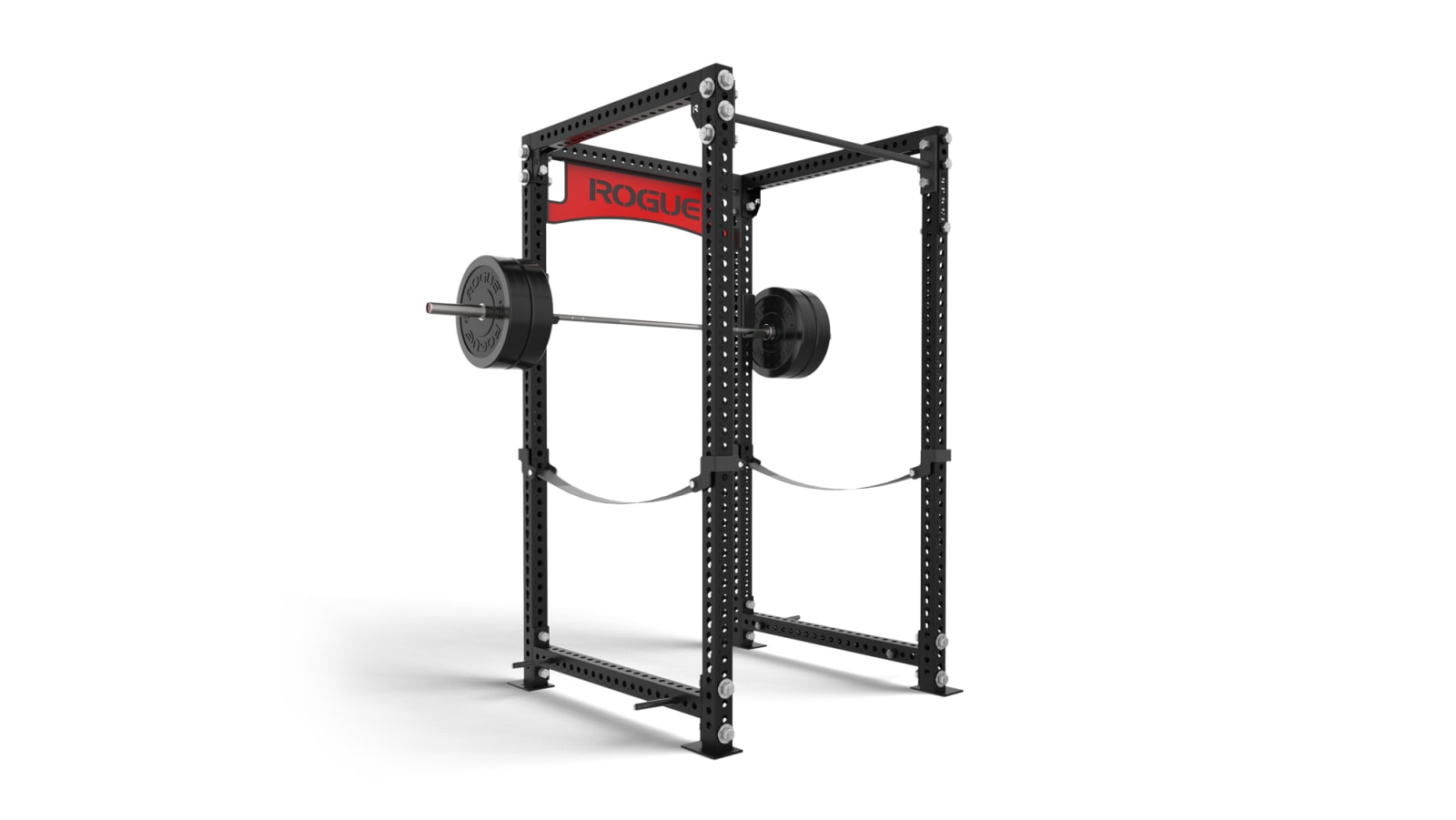
If American manufacturing is a real requirement, the Rogue RM-4 Monster is still one of the cleanest premium options.
It gives you true 3×3, 11-gauge steel, 1-inch Monster hardware, multiple height choices, a deep attachment ecosystem, and years of independent ownership history around Rogue’s Monster platform.
The tradeoffs are simple: it is expensive, the 49-inch width reduces bar-sleeve clearance compared with narrower racks, and the standard setup requires an anchoring or stabilizer decision.
I would buy the RM-4 because I specifically wanted the Rogue Monster ecosystem or American-made rack construction. I would not buy it because 1-inch hardware somehow makes a home gym safer by default.
Alternative: The Rogue
Best Value – Titan X-3
The X-3 is the value pick for buyers who want a serious rack platform without paying premium-rack money.
- Strong 3x3 value for the money
- 11-gauge frame and 5/8-inch hardware class
- Westside spacing where it matters most
- Multiple height and depth configurations
- Useful X-3 attachment ecosystem
- Safeties cost extra
- Titan recommends bolting it down
- Configured cost is higher than the frame price suggests
- One-year warranty is short compared with some premium competitors
- Fit, finish, and support are not the reason to buy it

The
The current bolt-down X-3 line gives you Westside spacing, a real attachment ecosystem, and the basic rack architecture most people associate with much more expensive models.
The catch is that the sticker price is not the whole price. Safeties are separate on the current configuration I verified, so I would compare the rack plus the safety option you actually want against other complete racks.
The other tradeoff is the ownership experience. Titan’s shorter warranty, more basic finish, and recurring QC/shipping complaints are part of why the rack costs less.
That does not make the X-3 a bad rack. Independent long-term owner evidence is generally much more positive about the structure than the finish and service experience.
Alternative: The ISF 90-inch 3×3 is the interesting cheaper-complete option if you want 3×3, 11-gauge, 5/8-inch and Westside-style fundamentals with J-cups and pin-and-pipe safeties included, but its fixed footprint and thinner ecosystem keep the X-3 ahead.
Best First Power Rack – REP PR-1100
The PR-1100 is the first full cage I’d point most beginners toward when they want a complete rack without spending serious-rack money.
- Low price for a complete four-post power rack
- 700 lb rackable capacity is enough for most home gym lifters
- Multi-grip pull-up bar is included
- Numbered uprights make repeatable setups easier
- J-cups and pin-pipe safeties are included
- Compatible with REP's 1000 Series lat pulldown, storage, landmine, and other basic attachments
- 3 in hole spacing makes precise J-cup and safety placement harder
- 2x2 in 14-gauge frame is less rigid than REP's 3x3 premium racks
- Cannot be bolted down
- REP does not recommend kipping pull-ups or muscle-ups on it
- Smaller attachment ecosystem than the PR-4000 and PR-5000
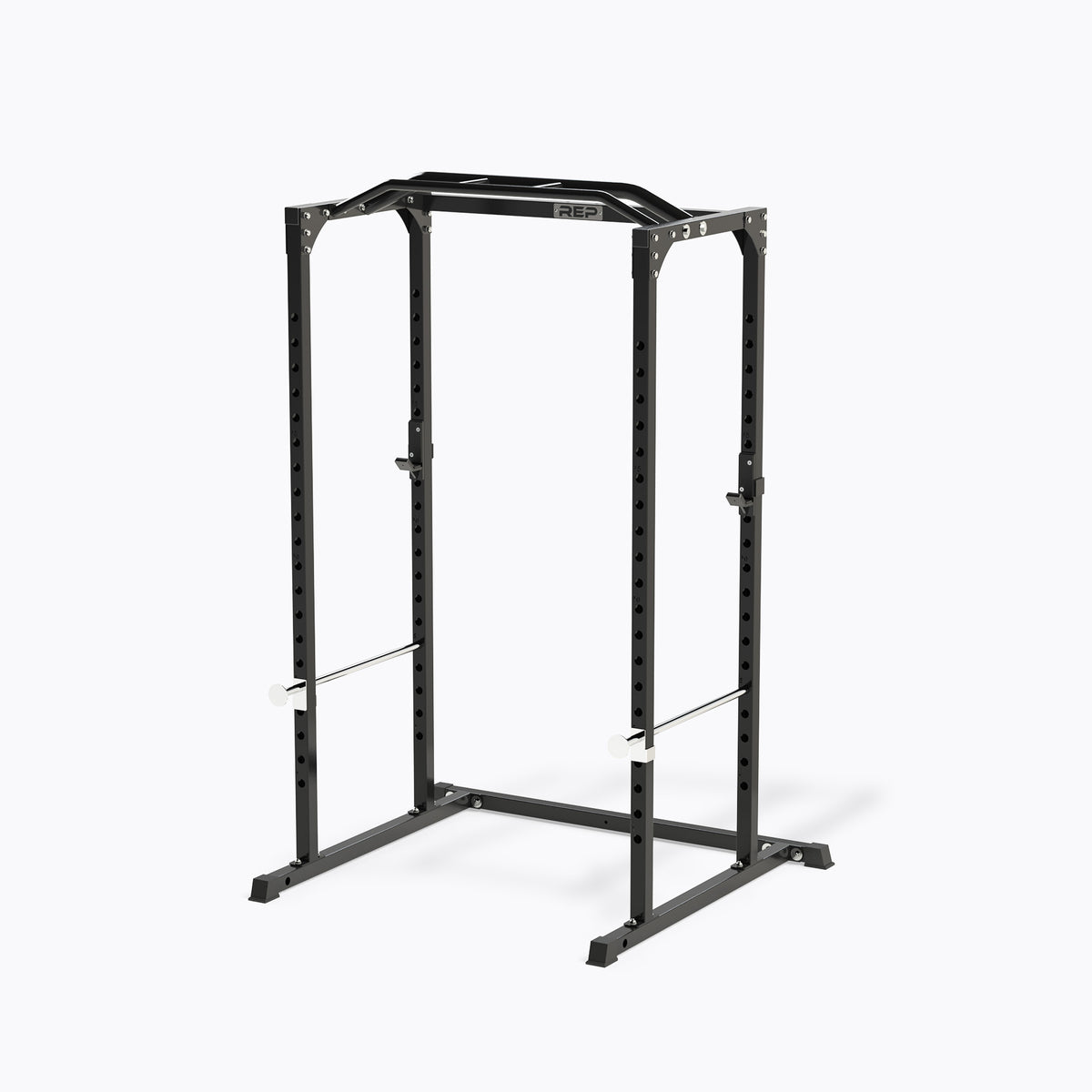
The PR-1100 is the rack I would recommend to somebody building a first real home gym who wants a full cage without spending serious-rack money yet.
At $379.99, it includes J-cups and pin-and-pipe safeties, uses a flat-foot design that does not require bolting down for normal use, and still has REP’s 1000 Series attachment path.
The compromise is exactly what you would expect at this price: 2×2 14-gauge steel, 3-inch hole spacing, a 700-pound published rackable capacity, and a much lower long-term upgrade ceiling than the better 3×3 systems.
If you already know you are going to add premium cables, a big attachment stack, or push into the kind of setup that makes the starter rack expensive, skip the side quest and buy the better platform once.
Alternative: The Fringe Sport
Best For Low Ceilings – Titan T-2
The T-2 earns its spot because the short version gives low-ceiling gyms a real full cage without forcing the room to fit the rack.
- 71-inch version fits rooms most full racks cannot
- 2-inch hole spacing is better than many starter racks
- J-hooks and pin-and-pipe safeties are included
- 850 lb published rackable capacity
- Useful 2x2 attachment ecosystem
- 2x2, 14-gauge frame is lighter than 3x3 premium racks
- Smaller long-term ecosystem than modern 3x3 platforms
- One-year warranty is short
- Short version compromises pull-up and overhead clearance
- Not the rack I would buy if you already know you want a bigger upgrade path

If your ceiling is the thing killing every normal rack option, the Titan T-2 is the full cage I would look at first.
The current T-2 comes in 71- and 83-inch versions, includes J-hooks and pin-and-pipe safeties, and has a real T-2 attachment ecosystem instead of being a disposable beginner cage.
I am using 14-gauge steel as the publishable specification. Titan’s own documentation conflicts, with a support entry showing 12-gauge while the current product and collection pages say 14-gauge. I am not going to pick the stronger number because it sounds cooler. That is not research; that is fan fiction. Until Titan or direct measurement proves otherwise, 14-gauge is the safe claim.
That is the right tradeoff to understand: the T-2 is cheap and useful, but it is still a lighter 2×2 platform with a much smaller long-term ceiling than the 3×3 racks above.
If you start adding enough attachments and cable equipment to make the T-2 expensive, I would stop and compare the total setup against a better rack instead of assuming expansion always makes sense.
Alternative: The 72-inch Bells of Steel Residential Rack is the one to check if you want a similarly short full cage with a flat-foot/no-bolt setup instead.
Best Folding Rack – PRx Profile PRO
The Profile PRO is the rack to look at when getting the floor space back after training matters more than having a permanent four-post cage.
- Gives back a huge amount of floor space when folded
- 3x3, 11-gauge frame is still a serious rack platform
- 1-inch bench-area spacing helps with bench setup
- 1,000 lb published rackable capacity
- Vertical fold is cleaner than a traditional side-folding setup for the right room
- Installation and wall geometry have to be right
- Permanent mounting is a poor fit for many renters
- More expensive than many freestanding racks
- Not a traditional four-post cage
- Ceiling clearance matters because the rack folds upward
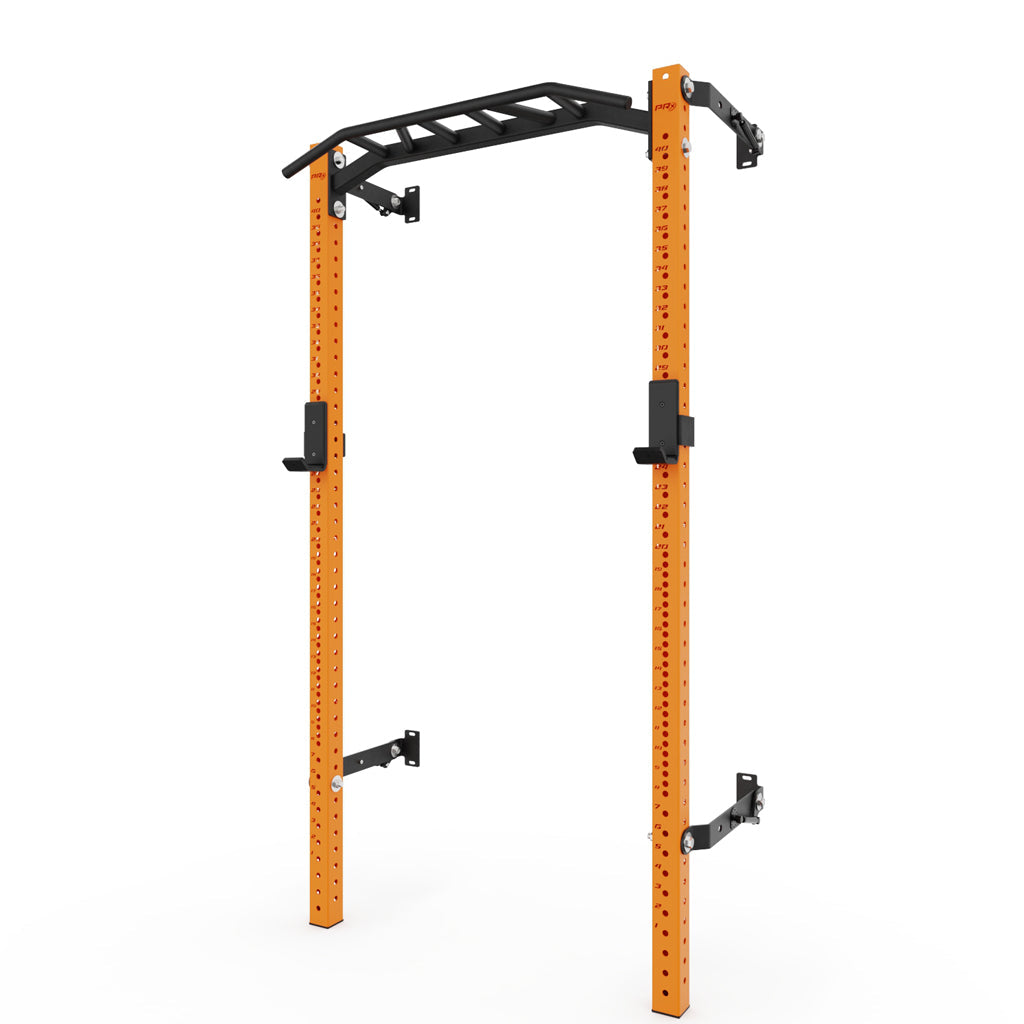
The PRx Profile PRO solves a different problem than the rest of this list.
It is a wall-mounted folding rack for people who actually need the floor space back when training is over.
If you have a dedicated gym room and can leave a normal four-post rack open permanently, I would rather have the normal rack.
If the garage still needs to hold a car or the room has to do another job, the Profile PRO becomes much more interesting.
The important warning is ceiling and installation geometry. The rack folds vertically, so the listed rack height is not the only measurement that matters. Wall structure, ceiling height, floor slope, and spotter-arm compatibility all need to be checked for the exact setup.
Alternative: The Rogue RML-3W is the cheaper 3×3 / 5/8-inch option if sideways fold-back storage works for the room and you do not need PRx’s vertical folding system.
Best Budget – Bells of Steel Light Commercial
The Light Commercial is the budget rack I’d choose when you want tighter spacing, included safeties, and a real cable-and-attachment path without jumping to premium pricing.
- Tight 1-inch spacing through the bench and pull zone
- Includes sandwich J-cups, roller J-cups, and safety straps
- Useful cable and attachment upgrade path
- 84.5-inch and 72-inch height options
- Strong value before you jump into premium 3x3 pricing
- 60 mm tubing is more proprietary than true 3x3
- Third-party attachment compatibility is more limited
- Rack-mounted lat pulldown only fits the standard-height version
- Not the best choice if an open cross-brand ecosystem is the priority
- Larger inside depth than some compact budget racks

The Light Commercial is the rack I would choose when a starter cage feels too easy to outgrow but jumping straight into a $1,200-plus 3×3 system is unnecessary.
The standard 84.5-inch version uses 2.3×2.3-inch 12-gauge tubing with 5/8-inch holes, 1-inch spacing through the bench and pull zone, and 2-inch spacing elsewhere. It also includes sandwich J-cups, roller J-cups, safety straps, band pegs, a multi-grip pull-up bar, and anchors.
The reason it wins this buyer job is the upgrade path. Bells has a dedicated lat-pulldown/low-row attachment for the 84.5-inch rack plus enough rack accessories that you can start simple and keep adding capability without immediately replacing the frame.
The tradeoff is the 60 mm ecosystem. It is not a true 3×3 rack, so it gives up the cross-brand compatibility ceiling of Hydra, Manticore, X-3, and Rogue-style systems.
Alternative: The RUGGED Warrior Y100 is the better fit if you care more about 2×3 11-gauge construction, Westside spacing, and a lifetime in-home warranty than Bells’ deeper cable/accessory path.
The Power Rack Decisions That Actually Matter
Most decent power racks are already strong enough for a normal home gym. The expensive mistakes usually happen somewhere else: buying the wrong size, choosing an ecosystem you do not actually want, underestimating how much room attachments take up, or comparing starting prices instead of what the rack costs once it is actually usable.
These are the things I would care about before spending the money.
1. Buy For The Room First
A great rack that does not fit your room is still the wrong rack.
Working depth is not the same thing as installed footprint. Rear storage, stabilizers, plate horns, cable stacks, feet, and Smith attachments can all turn a rack that looks compact on a product page into a much bigger piece of equipment once it is actually built.
Before I ordered anything, I would measure three things: the space between the uprights where I am actually going to train, the full installed footprint of the rack, and the clearance around it for loading plates, moving a bench, and using attachments.
If you are laying out the whole room at the same time, use my garage gym setup guide before you buy everything and discover that your carefully planned home gym now has the traffic flow of a Costco on Saturday.
Ceiling height needs the same treatment. Do not just compare the upright height to your ceiling and call it good. You may still need room above the pull-up bar for your head, extra height for cable towers, clearance during assembly, or enough open space for a folding rack to actually fold.
2. 5/8″ Vs 1″ Hardware Is Mostly An Ecosystem Decision
I would not buy a 1″ rack because I was worried that 5/8″ hardware was not strong enough.
That has never been the limitation on my PR-4000.
The real question is which attachment ecosystem you want to buy into.
Some companies put their newest or most premium attachments on the 1″ platform first. On the other hand, 5/8″ attachments are usually cheaper, and many 5/8″ racks give you Westside spacing through the bench area, which makes it easier to fine-tune J-cup and safety positions.
If you already know you want a specific set of premium 1″ attachments, buy the 1″ rack and be done with it.
If you mainly want to squat, bench, press, pull, use normal safeties, add storage, and maybe add cables later, a good 5/8″ rack is still more rack than most people will ever need.
3. “3×3” Does Not Always Mean The Same Thing
This is one of the dumbest parts of rack shopping because 3×3″ sounds like it should be a universal standard.
It is not.
Some racks use a true 3″ tubing dimension. Others use metric tubing closer to 75 mm. That difference means basically nothing when you are squatting or benching, but it can matter once you start mixing attachments between brands.
Single-pin attachments tend to be more forgiving. Multi-pin attachments, width-spanning attachments, and anything that needs several holes to line up correctly are where “basically the same size” can turn into “why the hell does this not fit?”
If mixing brands is part of your plan, look at the rack attachments you actually want before you choose the rack. Do not buy the rack first and assume every attachment labeled 3×3″ is automatically going to cooperate.
I have dealt with this on my own PR-4000. Some third-party attachments have fit a little loose, and I have used UHMW shims to tighten them up. That is a minor annoyance on a simple attachment. It becomes much more important when multiple holes need to line up.
4. Rack Width Matters More Than Another Stupid Capacity Number
People will compare a 1,000-pound rack to a 1,500-pound rack like they are preparing to squat a Honda Civic.
Meanwhile, they ignore rack geometry, which is something you can actually notice every workout.
A wider rack puts the uprights closer to the plates on a normal barbell. That gives you less room for error when you walk out a squat or come back in to rerack it.
That is why I would rather know three separate measurements: inside working width, outside upright-to-upright width, and total/base width.
Those are not interchangeable.
5. More Attachments Can Make The Rack Worse
Every rack company wants its rack to eventually become your entire gym.
That sounds great until every attachment starts fighting every other attachment for the same six holes.
A cable trolley can occupy the same upright space you want for J-cups. Rear plate storage can get in the way of bench positioning. A Smith attachment can change where you can use safeties. A cable system can add enough depth that the compact rack you originally bought is no longer very compact.
This is why I care more about feature interference than feature count.
I do not care if a company sells 70 attachments if installing the six I actually want turns the rack into an inventory-management simulator.
The useful question is not, “How many attachments can I buy?”
It is, “Does the rack still work like a normal rack after I install the attachments I actually want?”
6. Compare The Rack You Would Actually Own
Starting price is one of the easiest numbers to make look better than it really is.
If one rack includes J-cups and safeties and another makes you buy them separately, comparing the bare-frame prices tells you almost nothing.
I look at rack cost in three layers:
Starting price: What does it cost to get into the platform?
Safe, usable price: What does it cost once I add the stuff I actually need to train safely?
Recommended configuration: What would I realistically buy if I planned to keep the rack instead of building the cheapest possible version for a comparison table?
That is a much more useful way to compare value.
It is why the
A cheap rack is only cheap if it still does what you need after you are finished building it.
Other Power Racks Worth Considering
These did not make my main picks, but I would not write them off either. Each one still makes sense if its specific strength matters more to you than the tradeoff that kept it out of the top eight.
Sorinex XL Series Power Rack
- Why I’d Consider It – If I were building with basically no budget ceiling and wanted something closer to commercial equipment than a normal home-gym rack, the XL would absolutely be on my list. You get a 3×3″, 11-gauge platform with a lot of customization and a reputation built around serious strength facilities.
- Why It Didn’t Make My Main Picks – It costs over $3,000 before freight and customization and is made to order. I like what it is, but I do not think most home-gym owners get enough extra utility from it to justify spending that much when the main picks already solve the important problems for a lot less money.
Rogue R-3
- Why I’d Consider It – The R-3 is still a great option if you want a simple American-made rack with 2×3″, 11-gauge construction and Westside spacing. It is an old-school rack in the best sense of the word.
- Why It Didn’t Make My Main Picks – The 2×3″ format gives you a much smaller modern attachment ecosystem than the current 3×3″ platforms. I would still buy one if I wanted a simple barbell rack and did not care about turning it into Optimus Prime later. I just would not choose it if long-term attachment compatibility was one of my priorities.
Titan T-3
- Why It Didn’t Make My Main Picks – I would still lean toward the Titan X-3 for most people because the price difference usually is not large enough for me to give up the more modern 3×3″ platform. If the T-3 is on a substantially better sale when you buy, though, that math can change pretty quickly.
- Why I’d Consider It – The T-3 is still one of the better ways to get into a serious 2×3″, 11-gauge rack with Westside spacing without spending premium-rack money. It has also been around long enough to have a real attachment ecosystem behind it.
What Does a Power Rack Really Cost?
The cheapest number on the product page is usually the least useful number.
I would compare three prices.
- Starting price – the cheapest configuration the manufacturer can advertise.
- Usable price – what it costs to safely squat and bench once required J-cups, safeties, stabilizers, or other basic hardware are included.
- Recommended configuration price – what the rack costs after you choose the depth, safeties, storage, and upgrades that make sense for how you actually train.
That comparison keeps a cheap bare frame from looking artificially better than a rack that includes the hardware you need on day one.
It also keeps premium racks honest. A $1,500 rack can become a much more expensive project very quickly once you add premium safeties, storage, cables, and a Smith attachment.
Power Rack vs Squat Stand vs Half Rack
For a permanent home gym with enough room, I still prefer a full power rack.
The enclosed lifting area gives you a clean safety setup for solo squats and bench presses, and full racks usually give you the best long-term expansion path.
I would choose a squat stand when portability and floor space matter more than having a cage.
I would choose a half rack when I want rear storage and a more compact lifting area but still want something more permanent than a stand.
There is no prize for buying the biggest rack. Buy the format that fits the room and the way you train.
If you’re still deciding which rack style actually fits your space and training, my power rack buying guide breaks down power racks, half racks, squat stands, sizing, hardware, and the other things worth comparing before you buy.
Final Recommendation
The
I own it, I have used it for years, and I originally chose it over the PR-5000. I still don’t think most people need to spend more just to move from 5/8 inch to 1 inch hardware.
The PR-4000 gives you 3×3 inch 11 gauge construction, useful Westside spacing, a huge attachment ecosystem, multiple configurations, and enough room to keep expanding your gym without paying for features most people won’t use.
There are better choices if you specifically need a true imperial 1 inch ecosystem, American manufacturing, an ultra cheap first rack, extremely low ceiling clearance, or something that folds against the wall. Those are the exceptions covered above.
But if you asked me to choose one power rack and actually live with the decision, I would still buy the PR-4000.
Once the rack decision is handled, browse the rest of my home gym equipment guides to build out the rest of the setup without buying random crap you do not need.
Buy It, Wait, or Skip It?
Use the same simple scorecard for racks, barbells, benches, dumbbells, machines, attachments, and accessories before they take your money and floor space.
Score My Next Purchase →
0 Comments
Sort by